PLG Digest
Most teams measure activation wrong
We killed a product this week before building it. The crowded market was not what decided it.
From my week
We killed a product this week before building it. One of our founders ran the numbers and the competitive map and came back with the honest answer: he could not name a differentiator that was not already taken, the nearest comparable was still under $1M after years and heavy funding, and the space overlapped a company we already run. What decided it was the ceiling. Building to a few hundred thousand and then flatlining for want of demand is worse than not starting.
This week in PLG
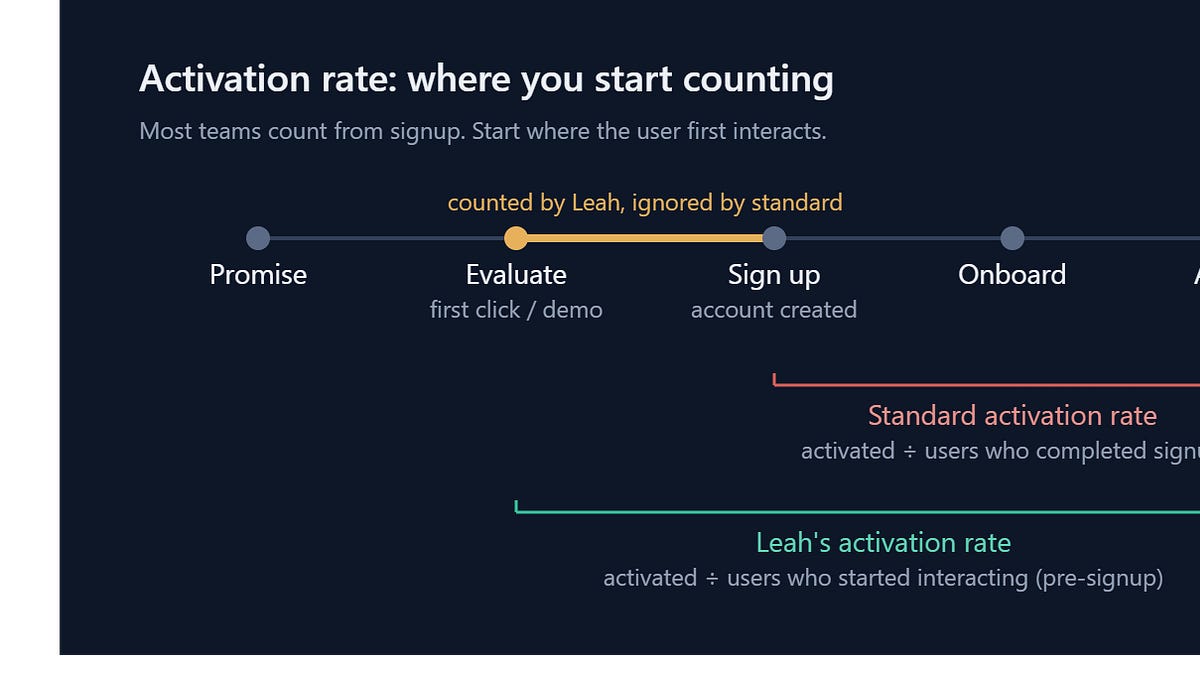
Leah Tharin argues most teams track the activation event that is easiest to instrument rather than the one that predicts whether anyone stays, which is how an activation rate looks healthy while free-to-paid sits flat. LiveDemo makes interactive demos cheap enough to put in front of people before they sign up. Merge's CEO walks through launching enterprise-only and adding self-serve afterwards. And a founder shares the early numbers from pricing per use instead of per month against a subscription incumbent.
Activation: the metric and the tools
You're doing "Activation" wrong (Leah's ProducTea, Leah Tharin)
The industry took activation as a concept and broke it, Leah Tharin argues. Most teams settled on a definition that was convenient to instrument, then spent years optimising against it. Worth reading with your own activation definition open next to it.
!You're doing Activation wrong
LiveDemo: Open-source alternative to Storylane, Navattic, and Arcade (Product Hunt, Aleksandar Blazhev)
Capture a workflow, add an AI voiceover, track engagement, then share it as a link, an embed, or a GIF. Storylane and Navattic price this out of reach for a lot of early-stage teams, so the interactive demo stays on the someday list well past the point it would have paid for itself. This removes the cost reason for putting it off.
PLG decisions with early data
Inside Merge: how they went enterprise-first, then reversed to PLG (GTM Newsletter)
Merge built their unified API platform enterprise-first, then reversed to PLG. Shensi Ding, the CEO, walks through the decision: why they launched without a self-serve motion and what prompted the reversal. The specific triggers and timeline are the useful part of this episode.
!Inside Merge: enterprise-first, then reversed to PLG
Launching my SaaS-only buyer database on Product Hunt. Here's the bet I made on pricing. (Indie Hackers, Joe)
Joe launched a SaaS-only buyer database with no subscription, charging per seat or per use instead. A few teams moved off Apollo and one of them cut its cost per meeting in half. The bet is that usage pricing wins in B2B data categories where the incumbent bundles far more than most buyers ever touch, and he shares the early numbers behind it.
Also worth a skim
From elsewhere this week: Kevin Indig on whether topical authority moves the needle in AI search, across 50,000 brands.
What FV is building
If you find the digest useful, you might find one of our tools useful too.
Rankwise: find where your site is invisible in AI search and fix it. Free AI Visibility Checker.
Debriefing: weekly competitive intelligence briefs delivered to your inbox.
_The PLG Digest is curated weekly by Founder Ventures. Reply to this email with what we missed._
PLG tips, weekly
Get the next issue in your inbox.